
A Revolutionary Antibody Discovery Technology
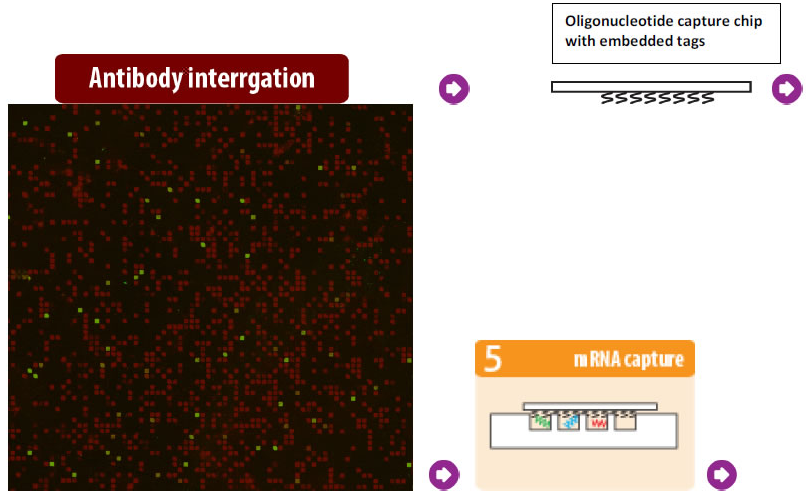
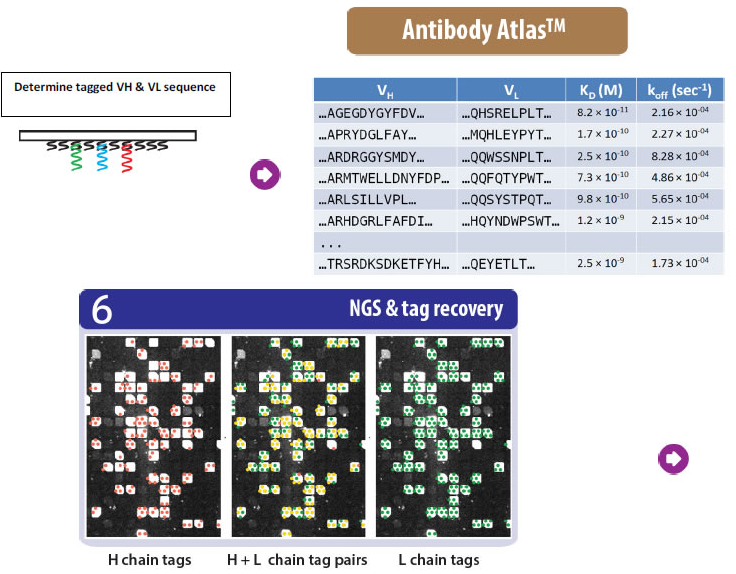
Antagene and its collaborator have developed a rapid antibody screen platform (Box “Process timeline”) which compiles comprehensive information for each antibody into a large database called the Antibody AtlasTM. Our precision engineered instrument (Box “Assay instrument”) accurately aligns and captures biomolecules from antibody producing cells onto multiple slides for consistent registration of phenotypic data (antibody affinity & specificity) and genotypic data (full length VH & VL). This novel and patented dual-assay antibody screen is unparalleled in the industry. If you are interested in finding those long sought-after antibodies, you will want to use our platform.
How does it work?

Project Details
I.Overview of the whole procedure
Procedure Overview
The run involves several key steps to assess the immune response and antibody characteristics from a cohort of mice:
- Pilot ELISPOT Assay
A pilot run of the ELISPOT assay is performed on splenocytes from a mouse in the cohort to quantify the number of antigen-specific antibody-producing cells. This assay helps determine whether immunization has been successful, with the expectation that the titer may correlate with the number of antigen-specific cells. - Isolation of CD138+ Cells
From a high-titer mouse, 20,000 CD138+ cells are isolated and deposited onto a picoliter device for further analysis. - Single-Cell Antibody Array (SCAA)
A single-cell antibody array (SCAA) is generated using the picoliter device. The array is then probed with a fluorescently labeled antigen, enabling the identification of antigen-specific antibody spots. Antibody affinity (KD) is measured for each spot. - mRNA Capture and cDNA Generation
An Agilent chip is used to capture the mRNA from all the cells on the picoliter device. This mRNA is then used to generate tagged cDNA, which is eluted for subsequent analysis. - PCR Amplification
The eluted cDNA is PCR-amplified to generate sufficient material for sequencing. - Sequencing
A single 2 x 250 bp Illumina MiSeq run is conducted to sequence the amplified cDNA. If the sequence is not long enough to cover the full-length variable (V) domains of the antibodies, a second sequencing run will be performed.
Deliverables:
- Kinetic Data Plot
A summary plot will display the distribution of all measured koff and kon values for each of the captured antibodies. - cDNA and Amino Acid Sequences Spreadsheet
A spreadsheet will be provided listing the cDNA and corresponding amino acid sequences for the variable heavy (VH) and light (VL) chains of all antigen-specific IgGs, along with each antibody’s kinetic measurements (KD and koff). - Paratope Clustering Dendrogram
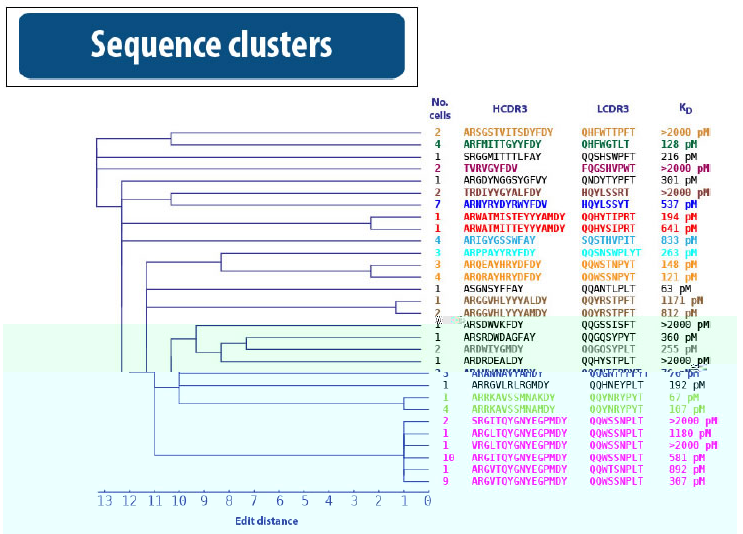
A dendrogram will be generated, showing concatenated HCDR3-LCDR3 sequences clustered into similar families, referred to as paratope clusters. Kinetic values (koff and kon) for each antibody member will be included in the dendrogram.
Pricing and Payment Terms:
The total cost for one run is $80,000. Due to the high cost of consumables, a payment of $40,000 is required upon contract signing. The remaining balance is due upon submission of the final report and successful dataset.
II. Antibody Cloning, Expression, and Purification

Phase 1: Cloning of scFv antibody from gene synthesis and production of antibody scFv fusion protein
6-8 weeks $20,000
1- Description: Clone the Vh and Vk sequence from gene synthesis into the mammalian expression vector
Deliverable: Gene synthesis product
2- Expression & purification of 10 mg of antibody scFv fragment protein
- Construction of mammalian expression vector
- Transient expression and purification of the fusion protein from mammalian culture supernatant
Note: Although scFv could be expressed in bacterial periplasm, solubility and folding is usually an issue and that formation of mixed forms is found quite often, even with a flexible GS linker between the variable domain. Secretary expression of the scFv fusion from mammalian cells in serum-free medium is therefore recommended for this project.
3- The reconstructed scFv antibodies will be assayed by ANTAGENE using ELISA to assess binding activities.
4- Depending on the nature of the antigen, ANTAGENE will perform appropriate functional assays to assess the scFv antibody’s therapeutic potentials.
Deliverable: 10 mg of the ScFV protein
Phase 2: Full length antibody expression
12-15 weeks $60,000
ACTIVITIES
5- Subcloning of antibody Vh and Vk variable regions gene into Antagene’s proprietary vector for full length antibody expression
6- Sequence confirmation of expression vector DNA
- Results will be delivered to Client via email
7- Transfection of host cell line (CHO-based) with expression vector DNA
8- Stable cell line selection and stabilization
9- Scale-up culture
10- Purification of supernatant from stable pools
11- Endotoxin and DNA/RNA removal
12- Characterization of antibody
-Concentration by UV280 - Purity by SDS‐PAGE
- Endotoxin, DNA/RNA concentration analyses
Phase 3: 1-2 weeks $10,000
DELIVERABLES
? Project report
? Sequence confirmation of expression vector DNA
? 50mg purified full length humanized anti-human mAb antibody
? Results from Characterization of antibody
- Concentration by UV280
- Purity by SDS‐PAGE
- Endotoxin, DNA/RNA concentration analyses
III Antigen related Technology:

a ) Antigen Preparation: Recombinant Protein Expression in Bacteria
1- Cloning of the genes into expression vector (tagged with 6xHis)
Total Time: 3-4 weeks Price: US $ 2,800
Protein Expression Service combines a variety of expression systems (bacterial and balcuvirus) with a full range of purification options, providing you with the material that you require for your application. The service spans vector construction through to purification of ready to use protein and can be tailored to meet your exact requirements.
A), Construct Generation:
- Clone coding sequence into one of a wide range of expression vectors
- The expression construct will be fully sequence verified
- Preparation of plasmid construct DNA
B), Assessment and Optimization: - Introduce plasmid construct DNA into bacterial
- Selection of over-expressing cells
- Small scale expression and purification study assessed by SDS-PAGE and
C), Western blot (anti-tag or specific antiserum) analysis - Estimation of protein yield
2-, Scale-up and Purification:
Total Time: 1-2 weeks, Price: US $ 1,200 - Large-scale growth of over-expressing cells
- Cells are harvested and lysed Protein typically purified from cleared lysate via
purification tag - Further purification to remove any contaminants e.g. gel filtration
- SDS-PAGE and Western blot analysis of purified protein
- Removal of purification tag and further SDS-PAGE analysis
- Determination of protein concentration
- Delivery of at least 10mg of purified protein ready for use in your application
b ) Antigen Preparation: Recombinant Protein Expression in Baculovirus
Total Cost: $6,300 + Cost of Gene Synthesis 9 weeks
- Gene Synthesis Gene Synthesis at $0.70/b
1 weeks - Clone the gene of interest into the suitable baculovirus transfer vector.
2 weeks at $1,000
-PCR/restriction enzyme digestion will be used to clone the gene of interest into a baculovirus transfer vector.
-If necessary, the sub-clone vector will be confirmed using restriction enzyme digestion and DNA sequence.
-The recombinant transfer vector will be prepared for further experimentation. - Generate the recombinant baculovirus for the target gene.
3 weeks at $2,500
-Transfect the insect cells (sf9 cells) with recombinant transfer vector and baculovirus DNA.
-The recombinant virus will be screened by plaque assay.
-The recombinant virus will be amplified to a 30mL high-titer stock. - Amplification of recombinant baculovirus for titer stock.
2 weeks at $850
-A 250mL high-titer virus stock will be generated from a low-titer stock of a recombinant virus.
-Several rounds of amplification may be required in order to increase the recombinant virus titer stock. - Protein Expression
1 week at $950
-One liter of insect cell culture will be generated.
-Cell pellet will be harvested and delivered. - Protein Purification
1 week at $1,000
-The protein will be purified using affinity column of His-tag and GST-tag recombinant proteins.
Total 9 weeks $6,300 + Cost of Gene Synthesis
Note:
-Purification development is not included and protein yield is variable under the baculovirus vector expression system.
-We offer and provide optimization for protein expression, which is based on M.O.I. and different cell lines. Optimization is optional.
-Price may vary depending on project.
C ), Antigen Immunization Protocol
Cost: $1,000
Mouse Immunization Protocol:
Subject:
Balb/c mice
Adjuvant:
Complete Freund’s Adjuvant (CFA) initially, followed by incomplete
Freund’s Adjuvant (IFA) for all subsequent injections.
Immunogen:
Typically, proteins and conjugated peptides. Amount of immunogen used
for each immunization is 0.1 mg /per mouse /per injection.
Procedure:
The immunogen is diluted to one mL with sterile saline and combined
with one mL of the appropriate adjuvant. The antigen and adjuvant are
mixed thoroughly to form a stable emulsion which is injected
subcutaneously and provides enhanced immune response from the
sustained presence of the immunogen.
Bleeds:
Blood is collected from the tail and allowed to clot and retract at 37°C overnight. The clotted blood is then refrigerated for 24 hours before the serum is decanted and clarified by centrifugation at 2500 rpm for 20 minutes.
Schedule:
Day 1
Bleed 0.1-0.2 ml.
1st Immunize with antigen in CFA.
Day 20
2nd Immunize with antigen in IFA.
Day 40
3rd Immunize with antigen in IFA.
Day 50
Test Bleed 0.1-0.2 mL for ELISA screen(internal quality control only, not provide to client).
Day 60
4th Immunize with antigen in IFA.
Day 70
Final Total Bleed 0.2-0.5 mL from Each mouse.